Platform
Our Capabilities
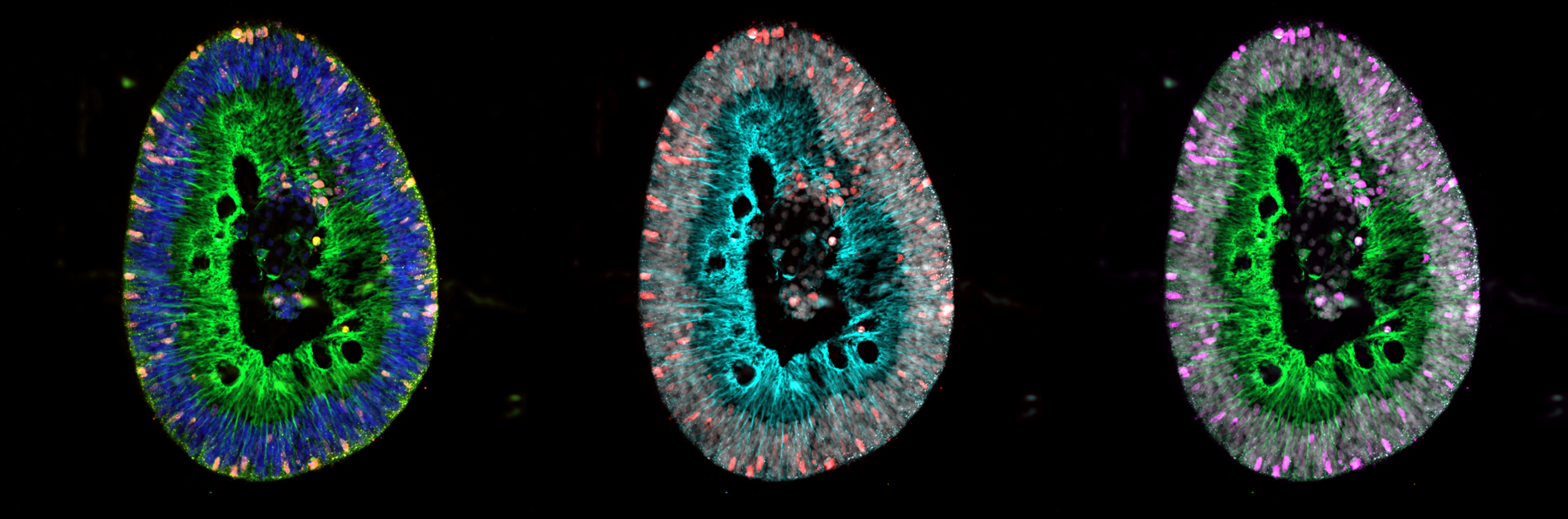
Immunofluorescence images of an early-stage retinal organoid (Day 21). Image: Munirah Santosa
To support our research into degenerative retinal diseases, including AMD and IRDs, we maintain extensively phenotyped patient cohorts alongside biobanks of patient-derived PBMCs and iPSCs that preserve disease-relevant genetic backgrounds.
These iPSCs serve as the foundation for our in vitro disease modelling platform, enabling the generation of RPE cells, photoreceptors, and retinal organoids that faithfully recapitulate key features of human retinal degeneration. Together, our clinical cohorts and stem cell-derived models provide an integrated pipeline from patient sample to mechanistic insight and therapeutic validation.

Optical Coherence Tomography (OCT) imaging of Non-Human Primate (NHP) model. Image: Daniel Wong and Liu Zengping.
Our in vivo modelling platform spans a range of species selected to capture complementary aspects of retinal biology and disease:
- Mouse — a tractable, well-characterised system for dissecting disease mechanisms and early-stage therapeutic screening
- Zebrafish — enabling rapid, high-throughput interrogation of gene function and drug response
- Rabbit — providing closer anatomical parallels to the human eye for evaluating therapeutic delivery and efficacy
- Non-human primate — the gold standard for translational safety and efficacy studies, given their close anatomical and physiological similarity to the human retina
Together, these models form an integrated pipeline from mechanistic discovery through to preclinical validation.